Coyote vs. Acme Review
Coyote vs. Acme is playing in theaters at the time of review. Rated PG. Common Sense says 7+
Coyote vs. Acme Review: Wile E. Coyote Finally Gets the Last Laugh
David Green's Coyote vs. Acme turns one of the oldest Looney Tunes jokes into a surprisingly heartfelt comedy about persistence, failure and corporate greed.
Some things in this world are simply facts of life. The sun rises in the east. Tokyo is in Japan. Christmas is in December. And every day, Wile E. Coyote—super genius—will hatch a plan to catch the Road Runner that spectacularly backfires.
Some people may look at Wile E. and see a bumbling fool. Some may look at him as an exercise in epic futility. Others may admire his grit. Coyote vs. Acme presents a different take: What if his failure doesn’t lie in his ineptitude? What if it’s all the fault of an uncaring corporate behemoth named Acme?
It’s a brilliant premise, taken from a 1990 New Yorker article written by Jerry Buchmeyer. The great triumph of Coyote vs. Acme is that it takes that premise—something that sounds like a classic six-minute SNL sketch—and turns it into a feature-length film that never loses its juice or wavers throughout its runtime.
Coyote vs. Acme Turns Wile E. Coyote Into a Real Character
The opening chase—evoking the classic Coyote and Road Runner shorts—sets the tone for the entire film. The hijinks escalate quickly, from faulty rocket skates to magnetic pellets to fighter jets to cruise missiles. The sequence isn’t imitation. It’s a continuation of what made the original Looney Tunes shorts so special. The chase ranks right up there with the best of Looney Tunes.
And then the movie lets us do what the old cartoons never did.
We follow the coyote home.
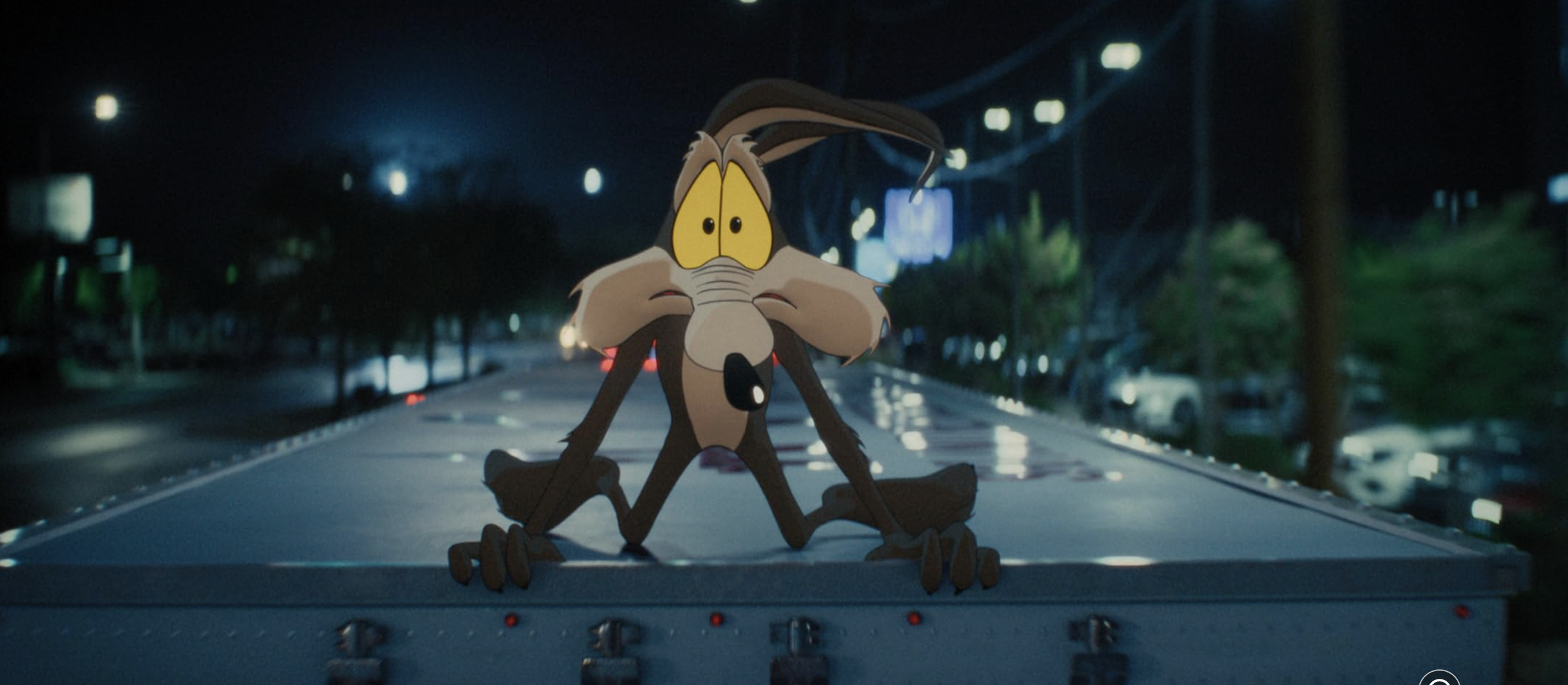
He’s covered in road rash and burn marks. He walks up the stairs like an aging offensive lineman whose knees will never be the same. And he’s crushed, physically and emotionally. But he pulls up a stool to his workbench, rolls out a fresh sheet of blueprint paper, sighs, and begins crafting tomorrow’s plan. In that moment, he becomes more than just a cartoon. He’s a full character.
He’s driven. He’ll endure whatever pain and humiliation is necessary to realize his goal. Failure is not an option. Put a ping-pong paddle in his paws, and we’d be hard-pressed not to see Marty Supreme running down the desert highways.
The screenwriters give him a perfect human counterpart: Kevin (Will Forte), a lawyer who’s been beaten down by life. The further Kevin got from his dreams, the more comfortable he became not chasing them. He specializes in “cartoon accident” cases, but he hasn’t seen the inside of a courtroom in years. He encourages his clients to settle quickly and cheaply despite the disapproval of his plucky intern, played by Lana Condor. Doing otherwise would risk failure.
The pairing of Kevin and Wile E. Coyote is more than an easy comedic setup. They’re polar opposites who have something to teach each other by the movie’s end.
Has our pop culture ever produced a more tenacious, determined character than Wile E.? Has it ever produced a more lonely creature who could use a lesson or two in the power of connection? Don’t get it wrong. This isn’t Shakespeare. These aren’t complex characters, but they ring extremely true. Director David Green and the screenwriters haven’t just expanded on Wile E. Coyote’s dynamics; they’ve made him a complex being in whom we can see ourselves, all while keeping the irreverent comedy intact.
The Animation and Live Action Blend Is Remarkably Seamless
Another of the film’s great achievements is its blending of two-dimensional, hand-drawn animated characters and real-life settings. It looks terrific and seamless on the big screen. An animated hole in the ground poses a risk to toons and humans alike. When bundles of TNT explode, everyone’s hair is burnt and blown back.
There’s a saying that the best referees are the ones you never notice. They don’t draw attention to themselves through bad calls or one-upmanship. They blend into the movement and flow of the game. The hybrid art design has the same effect.
It’s not revolutionary in the way that Who Framed Roger Rabbit was, when audiences were amazed by the new technology and couldn’t stop gawking at the screen. But that’s exactly what makes the visual effects in Coyote vs. Acme so impressive. The art design is remarkable for its sheer unremarkableness.
Its effectiveness allows us to “believe” that Wile E. Coyote and the rest of the Looney Tunes gang fully exist in our own world. The movie doesn't constantly remind us that we're watching an animated character interacting with live-action performers. It simply establishes the rules of its world and trusts us to accept them. That's much harder to pull off than it looks.
The Real Joke in Coyote vs. Acme Is Corporate America
There is also something unexpectedly appropriate about the film's central conflict. Wile E. Coyote is a cartoon character who has spent decades being abused by a giant corporation. Now he's finally fighting back.
That gives Coyote vs. Acme a little more bite than you might expect from a movie built around exploding dynamite and rocket-powered skates.
The film's themes of persistence, failure and corporate indifference don't overwhelm the comedy. They're simply woven into it. That's why the movie's heart never feels manufactured. Wile E.'s struggle remains funny, but there's also something oddly touching about watching a character who has failed thousands of times refuse to stop trying. And that may be the movie's greatest achievement.
Green, despite Warner Bros.’ best efforts to bury the film, has made one of the most delightful films you’ll see all year. It will appeal to all ages.
This movie may not scream “film school,” but it should be shown to budding filmmakers. It’s a film with a specific vision that executes every part of it perfectly. That should be the goal of any film, big or small, arthouse or blockbuster.