

Disclosure Day
Click the picture to see our full appearance!
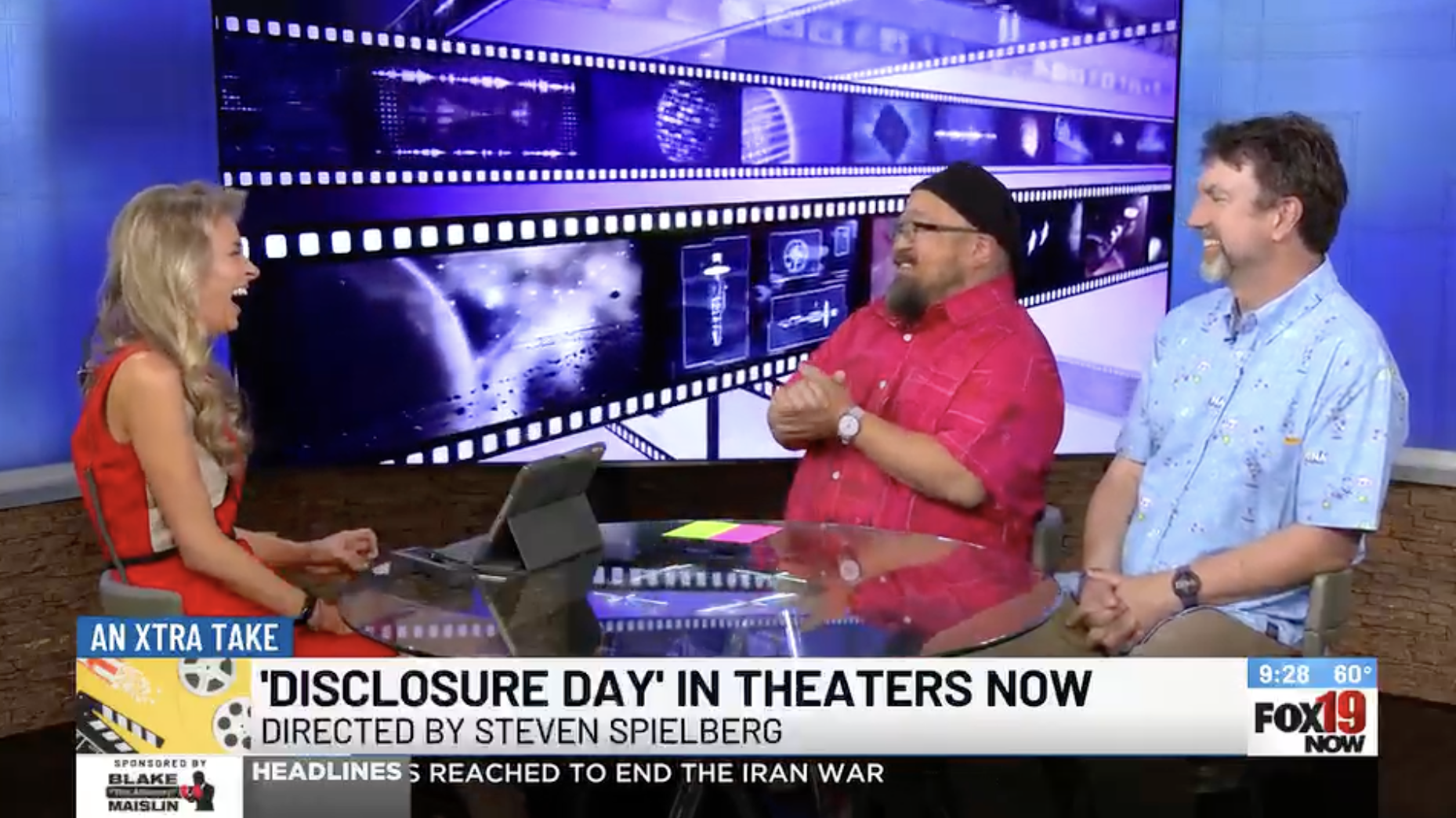
Disclosure Day is in theaters at the time of review. Rated PG-13. Common Sense says 13+
STORY: C
It’s over much too soon.
I’m not referring to its runtime, which is nearly two-and-a-half hours.
The film spends its entirety asking a question, but the moment it arrives at an answer, it bails.
It’s a cliffhanger ending, which is fine. But to make a sports analogy, Disclosure Day’s ending isn’t like the power going out as the final shot soars toward the basket. It’s more like turning off an entertaining game at halftime. There’s a lot of game left in this story.
Every movie should be judged on its own merit, and I don’t like to knock a film just because there’s an alternate version I would have liked much better. But in this case, I can’t help but think there were better choices for its final frame.
PEOPLE: A-
Blunt may want to keep her March 2027 calendar open.
Some may find it a stretch, but Blunt’s performance is definitely worthy of Oscar buzz, if not an outright nomination.
The stacked cast delivers great performances, but most of them play a single chord. Colin Firth is a human bazooka firing one villainous trope after the other at our faces. Josh O’Connor brings the sad-eyed earnestness he brought to Father Jud in Wake Up Dead Man. Colman Domingo’s assured, velvety voice washes over the proceedings.
But Blunt isn’t just playing different chords — she’s playing multiple instruments. She’s a plucky Kansas City meteorologist who dreams of bigger things. She’s got a complicated relationship with her longtime boyfriend (a jocular, slacker-adjacent Wyatt Russell who plays —again— one wonderful chord). Then in the blink of an eye, she mysteriously learns how to speak every language, gains the ability to read minds, and discovers she can set people’s souls completely at ease with just a glance. Blunt slays in each facet as she swims through a sea of emotions: fear, wonder, confusion, and fortitude. Oscar voters who appreciate the role’s range may very well reward her next spring.
FILM NERD STUFF: A
Spielberg revives his swashbuckling camerawork.
No one moves a camera quite the way Spielberg and his longtime collaborator Janusz Kaminski do. There are moments you’ll swear we’re back in the early Indiana Jones days.
This camera is an active narrator, always getting the final vote about what we get to see and when we get to see it. In one shot, a car races toward the camera, slamming on its brakes inches away from the lens. The camera then swings back, up, and away to reveal the precipitous cliff that the wheels stopped inches short of.
That narrative control is also present in quieter moments, such as a close, overhead shot of Daniel sitting on a motel bed. When he realizes he needs something from the bathroom, the camera zooms out to reveal the bathroom door. When he walks to it, the camera swoops down and follows him inside.
ONE BIG LESSON: A
Find your E.T.
I was 9 years old when E.T. first phoned home. I remember staring raptly at the screen, bursting with excitement that maybe I would be as lucky as Elliott and find an alien friend hiding in my closet when I got home. I doubt I’d have known how to feed it, teach it, or help it get home. But I am certain I would have known intuitively what Elliott and his friends knew: that letting adults get their hands on it would lead to disaster.
I don’t think Disclosure Day was intended as a companion piece, but I can’t help but look at it as what the story of E.T. would have been like had the adults found him first. Gone is the humor, the optimism, and the idealistic wonder. This is a world where rich men battle and bend laws in order to protect the world order.
The difference in the films’ tones reflects my own changes over the 44 years between movies. My youthful sense of wonder has been replaced with something I like to call a healthy cynicism. A revelation as massive as the existence of extraterrestrial life would bring seismic shifts to our world, and many of them would be positive. But I also know certain bad actors would use the event to exploit and further their own interests, benefits to all humankind be damned.
As much as I wish I could still walk around wearing E.T.-tinted glasses, I just can’t. We don’t live in an E.T. world anymore. Perhaps Spielberg’s choice to end the film when he does is his way of equiping us for living in this new world.
Sister Maura (Elizabeth Marvel) tells Jane (Eve Hewson), “You haven’t lost faith in God. You’ve lost faith in people.” I sometimes wonder if I’ve done the same. Disclosure Day suggests Spielberg hasn’t lost faith in people. He’s still rocking those E.T.-tinted glasses, and his worldview doesn’t reek of naivete. It smells like a superpower.
FINAL COMMENTS:
Even if it falls short thematically, this is Spielberg's best film in over a decade and his most enjoyable since his Minority Report - War of the Worlds era.